

This post may contain affiliate links. If you make a purchase through links on our site, we may earn a commission. Please read our disclosure policy.

Why I Love Mustard Pickles
I have never said no to a pickle. I earn that honestly from my Grandma Conrad. She loved pickles and always made a “pickle plate” for any event. Her plates of pickles were not just dill or bread and butter. No, they included sweet, lime, cinnamon, and other various pickled vegetables.
Her attention to detail always impressed me. If I swung by during cucumber season, her house always smelled of a sweet and tangy brine. Upon walking in, she immediately asked me to taste a few different pickles and give my thoughts. Sometimes, the only change was a teaspoon or two of salt. To her, that could make all the difference in the balance of a good pickle. She was right.

Two Types of Pickles
Let’s go over the 2 types of pickles and what defines each one:
- Canned pickles are often made with slices or spears of raw cucumber packed into canning jars with a hot vinegar brine poured over the top. Sealing lids and rings are added, followed by a variable amount of cooking time in a hot water bath. After a few weeks, they’re ready to eat and are shelf-stable for at least one year.
- Fermented pickles are an earlier form of preserving. The cucumbers are cleaned, often soaked in salt water for 24 hours, and then placed in a crock or fermentation vessel. It’s important to note that no vinegar is used in fermentation. A brine of water, salt, spices, and sugar (at times) is poured on top of the cucumbers. Over the coming days, the cucumbers ferment with the brine and create flavor. The brine needs to completely cover the cucumbers to prevent spoilage. After a certain number of days, when the pickles gain the desired flavor, they’re jarred up and kept in the refrigerator in a stable state for at least one year.

Which Type of Pickle are Mustard Pickles?
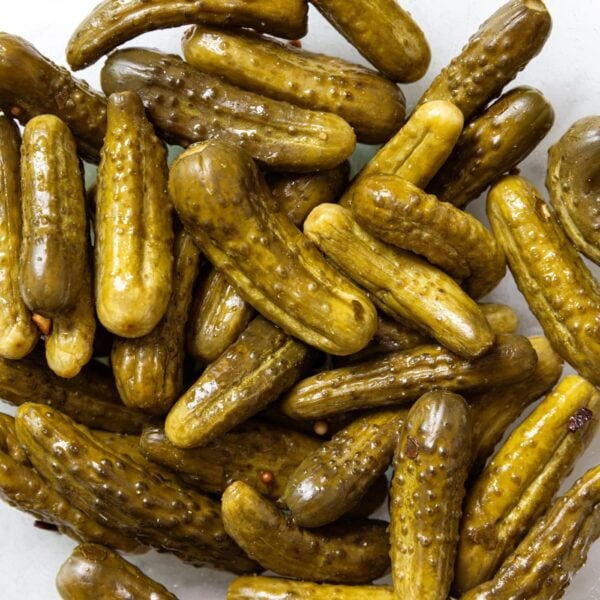
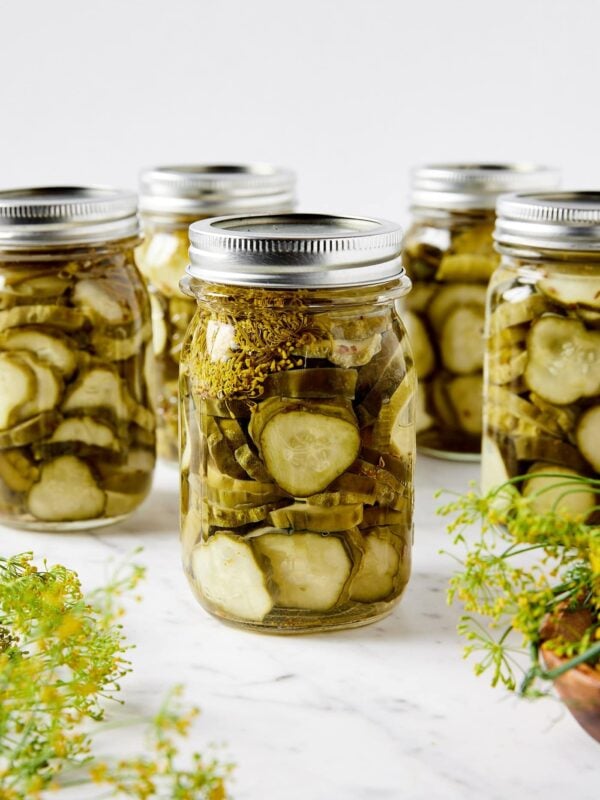
These mustard pickles are a hybrid pickle, acting as a combination of both canned pickles and fermented pickles. Classic pickling spices flavor the brine with an added boost of mustard powder. Now, it’s not a strong or astringent mustard flavor. Nope, just the right amount of balance, which Grandma tested and perfected over her years of experimentation.
The unique part of this recipe is the sugar added daily for 8 days, making this an 8-day pickle. The sugar sweetens these, but not to the point that you would assume. Instead of becoming a sweet pickle, much of the sugar is “eaten” in the fermentation process by good bacteria in the brine.
The result is a perfectly balanced pickle with an amazing sweet and tangy flavor.
Mustard Pickles Ingredients
- Cucumbers
- Ground mustard is made from mustard seeds ground into a fine powder. While it may sound similar, you do not want to use dry mustard in this recipe. Dry mustard powder is ground mustard that has been further formulated, sometimes with flour or other additives. Search for ground mustard when preparing these mustard pickles. I prefer McCormick Ground Mustard (affiliate link) and avoid Colman’s Mustard Powder.
- Pickling spice
- Sugar
- Vinegar
- Canning salt
The full amount of each ingredient can be found in the recipe card below.

Cucumber Sizing
The size of the cucumber is very important in this recipe. A cucumber that is too small will not hold up to the 8-day fermentation process, and one that is too large will be too seedy. You want to select cucumbers that are 1-3 inches in length, as they will provide the best end result.

How to Make Mustard Pickles
Step 1: Soak the pickles – In a large crock, place the cleaned cucumbers in the bottom. In a separate container, stir together the 1 gallon of water and canning salt until the salt has dissolved. Pour over the cucumbers, covering them fully. Let it sit for 24 hours, then remove the cucumbers and rinse them.


Step 2: Prepare the brine – In a large bowl, add the vinegar, mustard powder, sugar, kosher salt, and pickling spice. Whisk until combined.


Step 3: Add the brine to the pickles – Add the pickles back to the crock, layering them tightly. Pour the brine over the top. Place weights or a plate over the top to submerge the cucumbers in the brine.


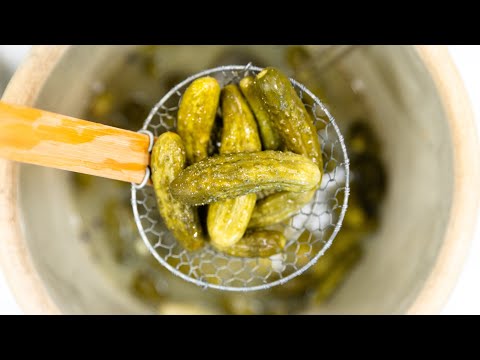
Step 4: Add sugar – Each day for 8 days, remove the pickles from the crock using a spider. Place in a large bowl. Add ½ cup of additional sugar to the brine and whisk together until dissolved. Add the pickles back in and add the weights. After 8 days, let the pickles sit for an additional week.


Step 5: Jar the pickles – Add the pickles to a jar. Strain the brine into the jar, fully covering the pickles. Seal the lid so it is airtight and place it in the refrigerator to store.


Recipe Tips
- Choose cucumbers that are the correct size. They should be bite-sized and easy to fit in a quart jar. Ones that are 1-3 inches in length are ideal. See the chart earlier for sizing.
- Weigh down the pickles with a plate. This is essential for the fermentation process. It pushes the pickles below the brine, allowing them to fully soak. If a pickle doesn’t stay below this, it can spoil quickly.
- Wipe down the inside of the crock after the pickles have sat in the salt water and before adding the brine. Foam can occasionally form, and this removes the excess.
- Once the mustard pickles are ready to be placed in jars for long-term storage, shaking/agitating the jar while adding the pickles will help them settle, pushing them together more tightly. This allows the brine to cover them fully.

Frequently Asked Questions
A true pickle only has a solution of salt, water, and some additional spices. This recipe utilizes that, but also uses vinegar.
These can be stored in the refrigerator for up to a year.
Personally, I love to eat them just as a snack, all on their own. However, they would be great paired with any type of summer barbecue recipe, such as the best grilled burger, creamy pasta salad, or even chicken sandwich. Some of the thicker mustard pickles could be sliced and added as chips on a sandwich.
Yes, the sugar can be reduced to taste. As with all fermentation, some of the sugar is consumed during the 8-day process. So, even though it may seem like quite a bit of sugar, the pickles do not end up being overly sweet. Since these will be stored in the refrigerator, the sugar content is not working as a preservation agent, which allows the maker to adjust to taste.

More Preserving Recipes
- How to can pickled beets
- How to can green beans
- How to can bread and butter pickles
- How to can hot pepper mustard
- How to can spicy dill pickles
- Bread and butter quick pickles
- Canned grape juice concentrate
- How to can tomato juice
- If you’re into preserving, make sure to check out my fermentation guide.
Have I Convinced You to Make This Recipe?
I hope you make this recipe and put some food on your table. Leave a comment and share a star rating so you can let others know how much you love this recipe. This helps show others that this is a recipe they, too, can make, enjoy, and love!
How to Make Mustard Pickles
Ingredients
- 5 lb small cucumbers (1" to 3" in length) cleaned
- 1 gal water
- 1 cup canning salt
- 4 cups granulated sugar separated
For the brine
- ½ gal distilled white vinegar (5%)
- 4 tbsp ground mustard
- 4 tbsp granulated sugar
- 1 tbsp canning salt
- 2 tbsp pickling spices
Instructions
- Mix together the water and salt until the salt is dissolved. Pour the water mixture over the cucumbers. Weigh down with a plate to ensure all cucumbers are covered. Soak for 24 hours.5 lb small cucumbers (1" to 3" in length), 1 gal water, 1 cup canning salt
- After 24 hours, remove cucumbers from soaking liquid and rinse.
- Place in a large 3- to 4-gallon crock or glass container.
- Prepare the brine.
For the brine
- Combine the vinegar, ground mustard, sugar, salt, and pickling spices. Stir to combine and dissolve sugar and salt.½ gal distilled white vinegar (5%), 4 tbsp ground mustard, 4 tbsp granulated sugar, 1 tbsp canning salt, 2 tbsp pickling spices
- Pour over the prepared cucumbers.
- Weigh down the cucumbers with a plate and jar of water to ensure all cucumbers are covered with liquid.
For next 8 days
- Daily, remove the pickles and add ½ cup of sugar. Stir until the sugar is dissolved in the liquid. Return the pickles to the liquid and weigh them down.4 cups granulated sugar
- After the 8th day, leave the pickles in the crock for 1 week.
- Put the pickles in quart jars. Strain the brine and pour over pickles in jars, covering pickles. Store in the refrigerator for up to 1 year.
Video
Notes
Nutrition
Nutrition information is automatically calculated, so should only be used as an approximation.

Did you make this? Leave a comment below!

These taste like “home” to me. I’m living in England and many of the pickles here are in the sweet side and it’s hard to find a nicely balanced tart with a hint of sweetness pickle. These go great in sandwiches and a burger in addition to any other possibilities you can think of. I’ve made these for two years now and will continue. Thanks Kaleb for being true to your heritage with your family recipes.
I followed the recipe to the T, but ended up with limp pickles and very cloudy, dirty brine.
Hi Mary! It sounds like you did everything perfectly! The pickles do look wrinkled when they are finished with the eight day process, especially because they are fermented at room temperature. Once they are stored in the refrigerator they have a great crisp texture. Of course, this can be dependent, sometimes, on the variety of cucumber as each can preform differently. The brine should be cloudy. Mine always is. That is from the mustard powder and the fermentation process!
I so want to taste these but am afraid I won’t like them and be stuck with jars or em. I have a small crock and am going to make a 1/4,recipe. All timing will be the same.
Hi. I have been enjoying your videos for the past few years now. Just bought a farm a property. Enjoying you landscaping, gardening and cooking tips. What size pickling container do you use. Also instead of a plate you can buy the weights and lid . I found some on Amazon and Walmart surprisingly . I have been searching all my local antique stores
I have terrific memories of my sister and I as young girls sneaking into the basement to steal a few of these pickles out of the crock. I have been searching for a mustard pickle recipe for years but have only found the pickled vegetables with turmeric recipe, until now. I am 3/4 through the recipe process and am ready to jar them in a few days…I am still sneaking them from the crock just as I did as a young girl. These are perfect and so, so delicious. I am so thrilled I came across this recipe. I was concerned about the amount of sugar at first but I “trusted the recipe” and it worked out great. Thanks so much.
Hi,
I was so excited to try this recipe, my pickles turned very soft, I still put them in jars & am now wondering if they will crisp up & are they safe to eat?
Would love to hear from you!
Hi Joy!
I am so glad you made these pickles! They are soft at room temperature when made in a crock. Like all home-canned or fermented pickles, the texture is softer at room temperature. Once they are jarred and stored in the fridge, they have more of a crisp-like texture. The softness has nothing to do with safety they are just fine!
I haven’t canned or made pickles in years, but this one really pulls me back into wanting to try and make them!
Love you 😍 you inspire me
I love your ideas and recipes and design you have. Most of all I am a dog lover and I love Kip…🐶🐾. I have a had time putting things together for design so watching you makes it so beautiful.
I look forward often to your videos, recipes, and gardening tips. I may just have to try these mustard pickles. They sound delicious.
Glad you are doing this. It is interesting. I seem to learn something new almost every video.
I first made a half batch of these pickles last year based on my love of Maine mustard pickles. These are even better. By the middle of the winter I was hoarding the remaining pickles and when they were gone I started dreaming about them. Making multiple batches this summer so I can give a few jars away. Maybe.