
This post may contain affiliate links. If you make a purchase through links on our site, we may earn a commission. Please read our disclosure policy.
How to Find Your USDA Plant Hardiness Zone (and use it correctly)
If you’ve ever bought a plant that you thought should have survived winter but didn’t, your USDA Plant Hardiness Zone is the first thing to check.
It’s a simple label, like 5b or 7a, that helps you choose perennial plants that can handle your winter cold or summer heat. The key is knowing what the zone does and doesn’t mean. Let’s run through the answers.
Quick Answer: How to Find Your Zone by ZIP Code
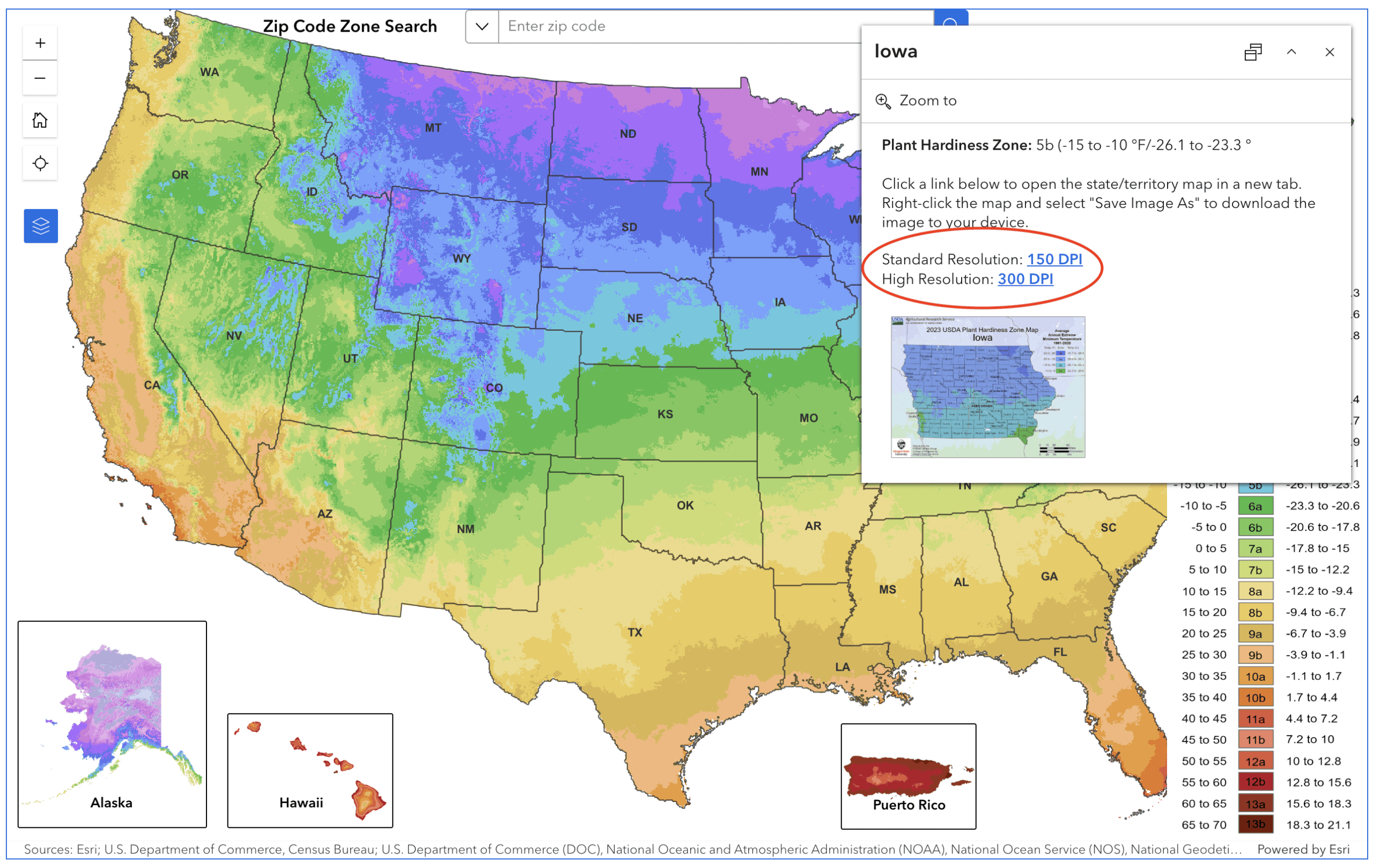
The most accurate place to look up your zone is the official USDA Plant Hardiness Zone Map.
- Go to the USDA Plant Hardiness Zone Map.
- Enter your ZIP code in the “Zip Code Zone Search” box. Once you hit “search,” you’ll see a dropdown box that informs you of your current Hardiness Zone, the previous Hardiness Zone, and the temperature change from 2012-2023.
- Click directly on the map where you garden to confirm the zone for your exact location (helpful when there’s a ZIP code that spans multiple microclimates).
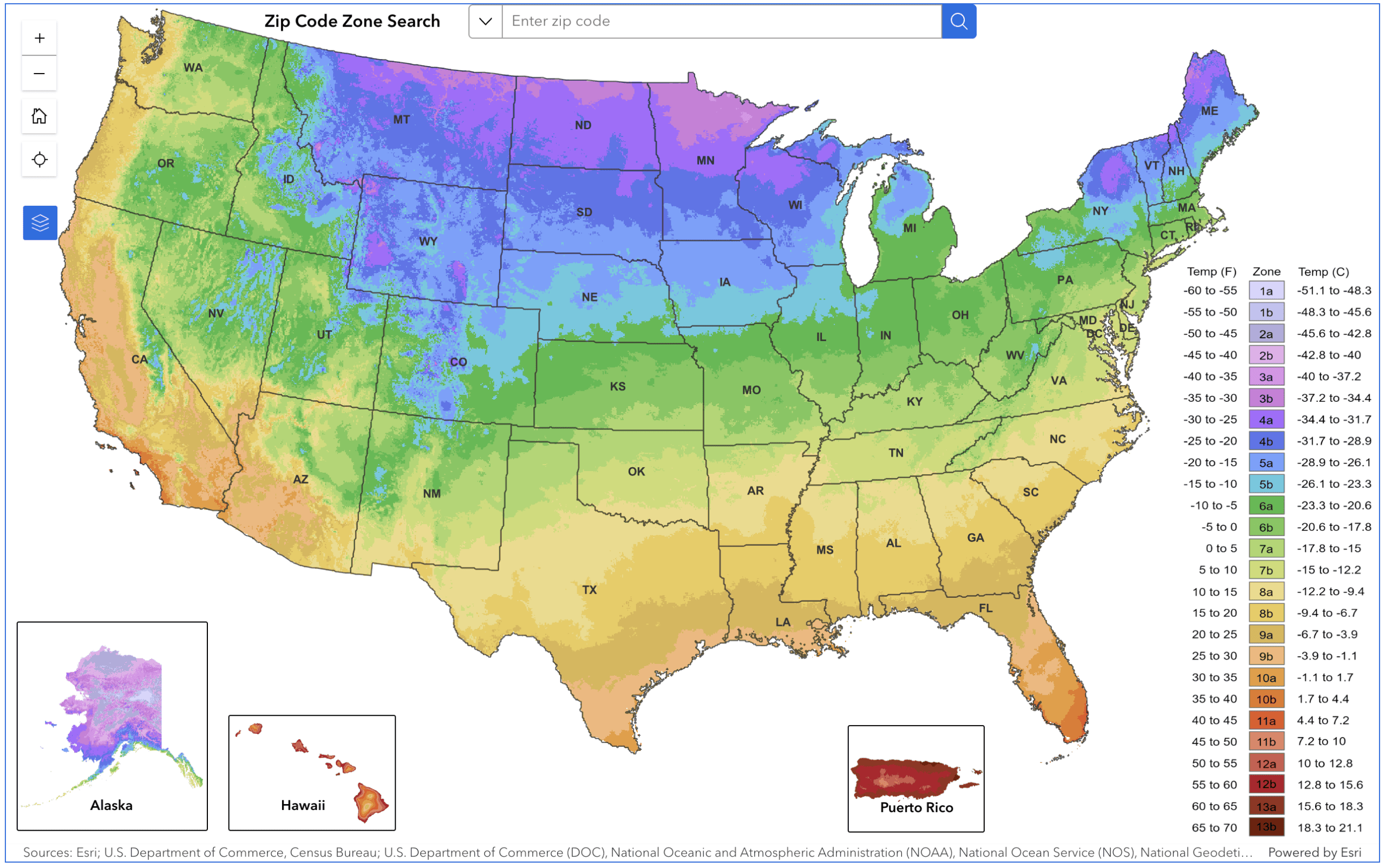
Want a printable reference? Download your state map (and other map files) from USDA’s Map Downloads page. Or you can click on a state and select the map (and resolution) you want to view.
What to Know
Key Takeaways
- Your USDA Plant Hardiness Zone tells you how cold your winters get, based on the average annual extreme minimum temperature.
- Find your zone fast by searching your ZIP code on the official USDA map, then click your exact location to confirm it.
- Zones are for choosing perennials (trees, shrubs, perennial flowers, fruit that overwinter), not for deciding when to plant tomatoes or zinnias.
- Zone designations “a” vs “b” matter. These half-zones represent about a 5°F difference in typical winter lows.
- Your zone is not a planting calendar. Use last/first frost or freeze dates for planting timing.
- Microclimates can shift what works in your yard, even within the same ZIP code (wind, snow cover, drainage, and exposure all matter).
- If your zone changed in the 2023 update, don’t panic. The USDA notes that plants already thriving will likely continue to do so. When the maps update, there is a gradual change with nuance, not overnight changes.
What USDA Hardiness Zones Actually Measure
USDA plant hardiness zones are based on the “average annual extreme minimum temperature.” In other words, they use the average coldest winter temperature for a location over a defined time period. A few important details:
- The map is displayed as 10°F zones (Zone 1 through Zone 13).
- Each zone is split into 5°F half zones, labeled “a” (colder) and “b” (warmer).
- The current USDA edition uses 1991-2020 weather data (a 30-year period).
Important – The USDA map is a guide, not a guarantee. It is based on average extreme minimum temperatures, not the coldest it has ever been or ever will be.
Example
What the USDA Map Looks Like in Iowa
I live and garden in Iowa, so I wanted to show you a concrete example of plant hardiness zones. The Iowa State University Extension notes that nearly all of Iowa is now in Zone 5, with much of the northern half in 5a and the southern half in 5b, based on the updated USDA map released in November 2023.
For me, since I’m in the southern half of the state, my plant hardiness zone is 5b. Make sure to check out my Zone 5b planting calendar and gardening checklist.
What Hardiness Zones Are Good For
Hardiness zones are especially useful when choosing:
- Trees and shrubs
- Perennial flowers
- Perennial herbs
- Fruit plants that are outdoors during the winter
Use your zone designation as a winter survival filter for plants that need to live outdoors year after year. This is why zones appear on plant tags and in nursery catalogs. That way, when you’re purchasing a new plant, you can easily reference the tag to know if it will survive in your zone.
For example, if you are in zone 5, like me, you can easily buy any plant rated for zone 5 or lower.
What Hardiness Zones Do Not Tell You
This is where many gardeners get tripped up.
1) Your zone does not tell you when to plant in spring – Zones are about the lowest winter temperatures, not spring warm-up times, soil temperature, or even the last frost date.
2) The zone map does not include a lot of factors that affect survival – University Extension resources point out that the USDA map does not account for things such as:
- summer heat and heat accumulation
- length of growing season
- snow cover
- wind exposure
- soil drainage and fertility
- plant health and how it is managed
The USDA also emphasizes that factors such as wind, soil moisture, humidity, snow, winter sunshine, and plant placement can strongly affect survival.
USDA Zone vs Frost Dates
Here’s the simplest way to think about it:
- USDA zone = winter survival for perennials (average coldest winter temperatures)
- Frost and freeze dates = planting timing for tender plants (tomatoes, basil, zinnias, peppers, etc.)
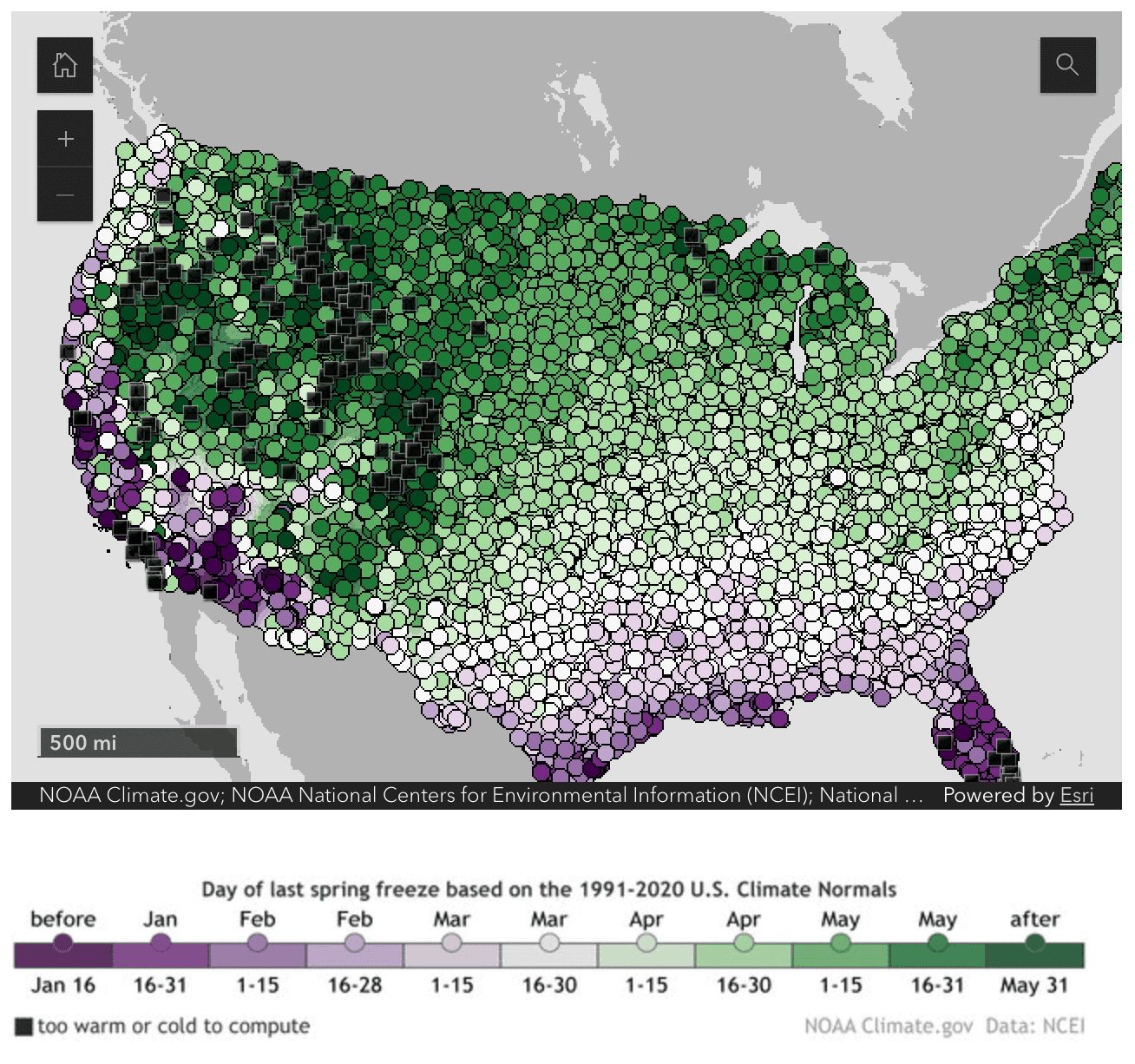
NOAA’s National Centers for Environmental Information (NCEI) publishes maps and data products derived from the 1991-2020 U.S. Climate Normals that help estimate things such as the average last spring freeze and first fall freeze.
Here’s the practical takeaway:
- Use USDA zones to pick perennials that can survive winter. Find your zone on the USDA website →
- Use freeze and frost guidance to decide when it is typically safe to plant annuals and vegetables. You can find your own average last spring frost date on the NOAA website →
Microclimates: Why Your Yard May Not Behave Like the Map
Even with the most detailed USDA map to date (drawn at a very fine scale), microclimates can still be smaller than what any national map can realistically show.
A few common examples that the USDA calls out:
- warm pockets near pavement or south-facing walls
- cool “frost pockets” where cold air pools in low spots
- sheltered areas that stay warmer than exposed areas
How to Use Your Zone Like a Pro
1) Start with the zone, then match the site – The zone designation gets you in the right category. Then the amount of sun, soil criteria, spacing, and care determine whether a plant thrives.
2) Be conservative with borderline plants – If you want more certainty, choose a plant that’s rated one half zone (or even one full zone) colder than your site. I will sometimes do this on my own farm in Iowa because I live in a very open area, where winter winds can be brutal.
3) Remember that “average” does not mean “never” – The USDA notes that plants can be lost in a rare, extreme cold snap even if they have been fine for years, because the map is based on averages.
Frequently Asked Questions
They are based on the “average annual extreme minimum winter temperature,” displayed as 10°F zones with 5°F half zones.
Use the USDA’s official map, enter your ZIP code, then click your exact location on the map to confirm your zone.
The USDA says a zone change does not automatically mean you should remove plants or change what you grow. What has thrived will most likely continue to thrive. And to be honest, in most cases, the zones are usually getting warmer, so your plants shouldn’t be in too much danger.
No. Frost and freeze timing come from other climate data products. NOAA provides maps and information about the average last spring freeze and first fall freeze based on U.S. Climate Normals.