


This post may contain affiliate links. If you make a purchase through links on our site, we may earn a commission. Please read our disclosure policy.

Why I Love These Pickles
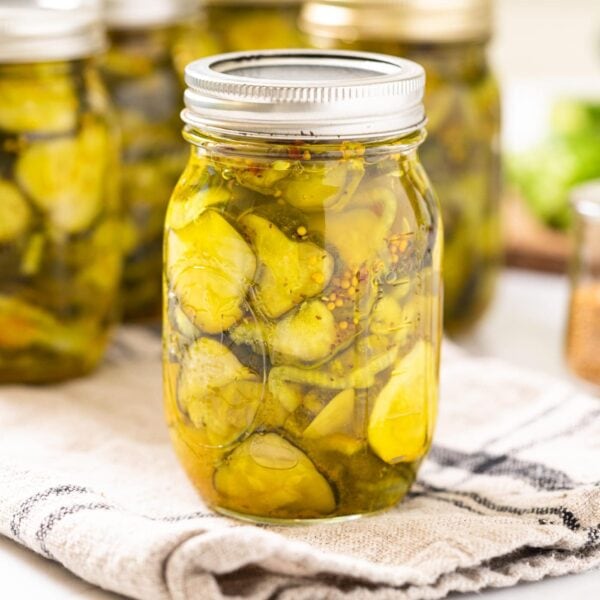
Bread and butter pickles are the pickles that almost everyone loves. They have a balance between tangy, sour, and sweet. It’s just enough sourness to tickle the side of your cheek, but it soon leaves with a pleasant sweetness left behind.
Like a lot of homemade goods, you can now easily find packets that only require vinegar and water to create the pickling brine. They work and taste fine, but are also packed with excess sugar and salt. This alternative tastes better while reducing the amount of sugar and salt.
This recipe offers a completely homemade approach. The mixture has simple ingredients that come together for a perfectly simple and craveable pickle. And this recipe takes refrigerator pickles one step further, allowing them to be stored year-round.

Bread and Butter Pickles Ingredients
The ingredients for bread and butter pickles are seasonal and full of delicious flavors!
- Cucumbers are the base for this recipe.
- Onions add a tangy flavor.
- White vinegar and water provide the base for the brine, which is necessary for pickling. White vinegar is best to use instead of apple cider vinegar because of its pure, neutral flavor and color.
- Canning salt seasons and removes moisture from the cucumbers.
- Granulated sugar sweetens the brine, balancing out the tanginess.
- Turmeric provides earthy warmth and color to the pickles.
- Mustard seed and celery seed add earthy and fresh flavors.
- Cloves bring sweet and aromatic notes.
- Red pepper flakes spice up the pickles, adding just enough smoky heat.
The full amount of each ingredient can be found in the recipe card below.

Food safety tip – Home canning is safest when you follow research-tested recipes and proper processing times. Improper canning can risk botulism. New to canning? See my Canning 101 Guide and consult the USDA Complete Guide to Home Canning.
How to Make Bread and Butter Pickles
There are 5 steps to canning bread and butter pickles:
Step 1: Prepare the cucumbers – Cut the cucumbers into slices, removing the ends. Add to a large bowl with the sliced onion and canning salt, and mix everything together. Let the mixture sit for 4 hours in the fridge. Then, discard any remaining ice, remove the cucumber and onions from the bowl, and place them in a colander to finish draining.


Step 2: Get supplies ready – Make sure to have your jars, lids, rings, and water bath ready for canning so you’re prepared when the brine is added to each jar.
Step 3: Create the pickling brine – In a medium saucepan, add the vinegar, water, sugar, turmeric, cloves, celery seed, mustard seed, and red pepper flakes. Bring to a boil, then reduce to a simmer to keep the brine warm.


Step 4: Pack the jars – Pack the cucumbers and onions in sterilized jars, leaving about ½-inch of headspace. Then, pour the brine over each jar, maintaining the ½-inch headspace. Inspect each jar for air bubbles. If one is discovered, use a knife to slightly agitate the pickles, releasing the air bubbles to the surface. Use a paper towel dampened with hot, sterilized water to wipe the rims of the jars. Place cleaned lids on top. Tighten down with rings to fingertip tightness.


Step 5: Water bath – Bring a pot of water with a bottom rack to a boil. Add in the jars, ensuring they’re covered by 1 inch of water. Bring it back to a boil and cook based on USDA altitude time guidelines shown below. Remove from the pot and let sit for 12 to 24 hours. Remove the rings and check for proper sealing. If the lid is indented down and the lid is snug, the jar is shelf-stable. Store in a cool, dark place. Refrigerate after opening.
Processing Times
Each altitude can require a different processing time. I’m located between 0 and 1,000 feet above sea level. If you are at a different elevation, make sure to check the USDA Canning Guide for your processing time:
| Elevation | 0 to 1,000 ft | 1,001 to 6,000 ft | 6,000 ft + |
|---|---|---|---|
| Time | 10 minutes | 15 minutes | 20 minutes |


Recipe Tips
- Remove about ¹⁄₁₆-inch of the ends from the cucumbers. These ends can contain a bitter enzyme in the ends of the pickles that can affect the taste and texture of the pickle.
- Use canning salt for this recipe. Canning salt is non-iodized, so it lacks the additives that are in traditional salt. This is not a huge deal, as this is not a fermented pickle, but it still helps to reduce the number of preservatives. In the case of a fermented pickle, additives should never be used, as the fermentation can be inhibited.
- After adding the pickling brine, inspect each jar for air bubbles. If one is found, slide a knife down into the canning jar to remove the bubble. These bubbles can compromise the safety of the canning process and should be removed if possible.
- Tightening the rings properly is essential for canning. The rings should be placed on to fingertip tightness. At this point, they snugly fit on the jar but are not tightened to an extreme degree. If they are too loose, the jar will not seal properly. If they are too tight, the jar may buckle, again producing an unsealed jar.
Follow These Tips
Serving & Storage
To serve – These pickles can be enjoyed on burgers, sandwiches, or just by themselves as a snack. I recommend using them on any of these sandwich recipes:
- Quinoa squash burgers
- The best grilled burgers
- BBQ chicken sandwiches
- Grilled pork burgers
- Classic sloppy Joes (if you like a pickle on your sandwich)
To store – After waiting for 24 hours to ensure the lids have sealed, remove the rings. Store the jars in a cool, dark place. Once a jar is opened for consumption, place it in the refrigerator. These will last about 1 year on the shelf and 2-3 weeks once in the fridge.
What Makes These Pickles Unique?
I always ask myself: why do so many of us seek out a bread and butter pickle? I think it’s due to one main thing. Dill pickles have one main spice/herb that’s used: dill. They’re often on the sour side with a strong briny bite.
In contrast, bread and butter pickles use a blend of turmeric, clove, celery seed, and red pepper flakes for a rounded-out flavor. None of the spices stand out, but all blend together for a richer taste. The brine is heavy on vinegar but is balanced out with sugar to give a slight sweetness. This all creates a perfectly neutral pickle that both sour and sweet fans like.

Can Any Cucumber Be Used for Pickles?
I grow various types of cucumbers, and they can all be delicious when they are made into pickles. But there are a few things to know about which varieties work best.
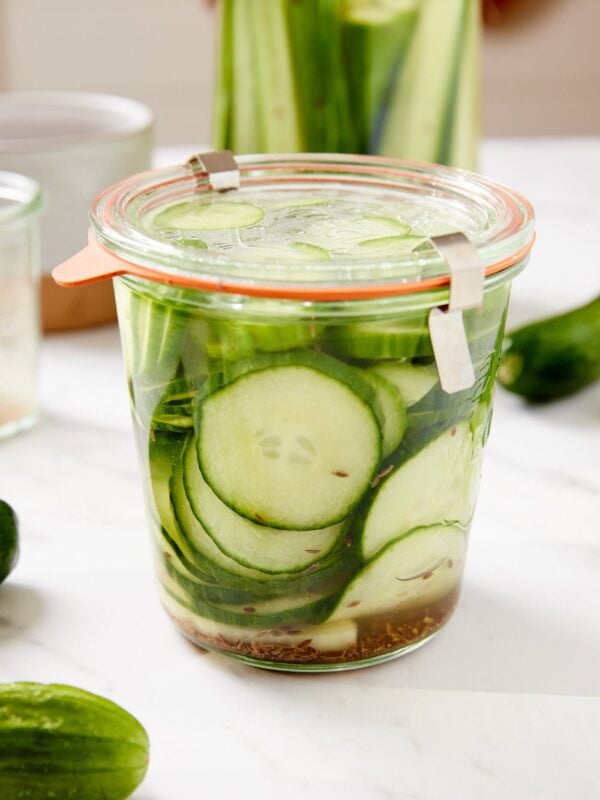
Most homegrown cucumbers are called pickling cucumbers and have telltale, distinctive bumpy skin and a smaller size. Smaller cucumbers, in the range of one to two inches, have fewer seeds in the middle, which makes them perfect for slicing into chips or spears.
While they may be easier to find, the smooth-skinned English or hothouse-style cucumbers are not the best option. They tend to get soft once canned. No one wants that!
If possible, it’s best to stick with a pickling cucumber.
Frequently Asked Questions
It’s up to you! The cloves can be strained out, but it’s not necessary to remove them.
Not all is lost! Simply place the jar into the fridge and enjoy. You may want to wait a few days to allow the flavors to fully develop before eating, however.
Once the jars have been appropriately sealed, they should be stored in a cool, dark place and should be consumed within 1 year.

More Pickle Recipes
- Refrigerator dill pickles
- Quick pickled carrots
- Canned dill pickles
- Bread and butter quick pickles
- How to make mustard pickles
- How to can spicy dill pickles
- Check out all of my pickle recipes!
- If you’re into preserving, make sure to check out my fermentation guide and learn all about preserving, including my canning 101 guide.
Have I Convinced You to Make This Recipe?
I hope you make this recipe and put some food on your table. Leave a comment and share a star rating so you can let others know how much you love this recipe. This helps show others that this is a recipe they, too, can make, enjoy, and love!
Canned Bread and Butter Pickles
Equipment
Ingredients
- 6 pounds pickling cucumbers 4-6 inches in length
- 3 medium onions sliced
- ½ cup canning salt
For the brine
- 3 cups distilled white vinegar (5%)
- 2 cups water
- 2 cups granulated sugar
- 1 ½ teaspoons turmeric
- ½ teaspoon whole cloves
- 1 ½ teaspoons celery seed
- 2 teaspoons mustard seed
- ½ teaspoon red pepper flakes
Instructions
- Prepare the cucumbers: Cut ¹⁄₁₆-inch off the blossom end of each cucumber and discard. Cut into ¼-inch slices. Combine cucumbers, onion, and salt in a large bowl. Mix to combine and cover with ice cubes. Refrigerate for 4 hours, adding more ice as needed. Then, discard any remaining ice and remove the cucumbers and onions from the liquid, placing them in a colander to finish draining.6 pounds pickling cucumbers, 3 medium onions, ½ cup canning salt
- Prepare the water bath: Get ready 8 pint jars with lids and rings, and have your water bath canner ready so everything is set when the brine is added.
- Prepare the brine: In a 4-quart kettle, combine the vinegar, water, sugar, turmeric, cloves, celery seed, mustard seed, and red pepper flakes. Stir to dissolve the sugar and bring to a boil. Reduce to a simmer to keep the brine warm.3 cups distilled white vinegar (5%), 2 cups water, 2 cups granulated sugar, 1 ½ teaspoons turmeric, ½ teaspoon whole cloves, 1 ½ teaspoons celery seed, 2 teaspoons mustard seed, ½ teaspoon red pepper flakes
- Prepare the jars: Pack sterilized jars with drained cucumbers and onions, leaving ½-inch headspace. Pour brine over prepared cucumbers and onions, maintaining the ½-inch headspace. Inspect each jar to ensure there are no large air pockets. If so, use a knife to agitate the brine to remove the bubble. Wipe the rims of the jars with a clean cloth to remove any drips. Place on lids and rings, tightening to fingertip tightness.
- Water bath: Bring a pot of water with a bottom rack to a boil. Place jars in the boiling water bath, ensuring they're covered by 1 inch of water. Bring back to a boil and boil for 10 minutes. Process for 10 minutes (see the chart in the post above and adjust the processing time if your altitude is above 1,000 ft). Remove from the water bath and cool for 12-24 hours. Remove rings to ensure a good seal and store for up to 1 year in a cool, dark place.
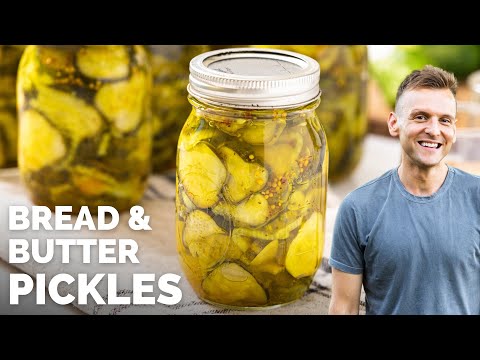
Video
Notes
Nutrition
Nutrition information is automatically calculated, so should only be used as an approximation.

Did you make this? Leave a comment below!

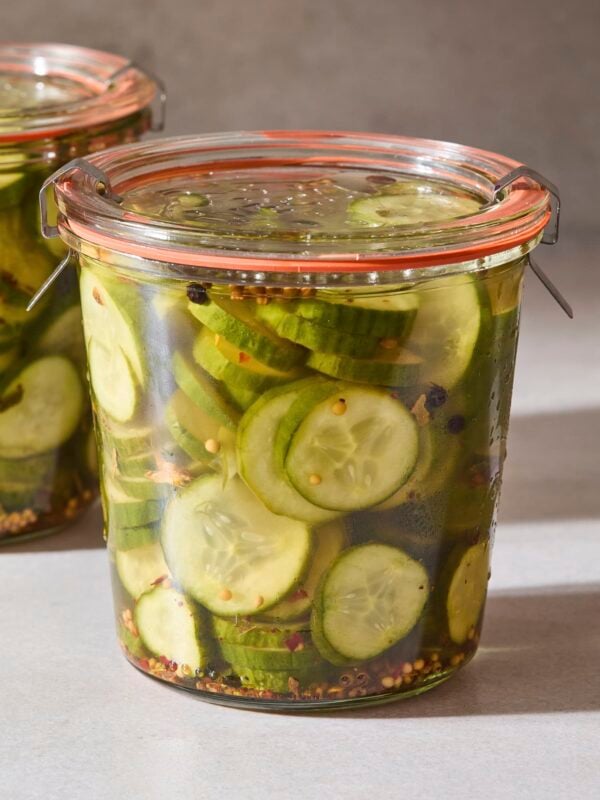
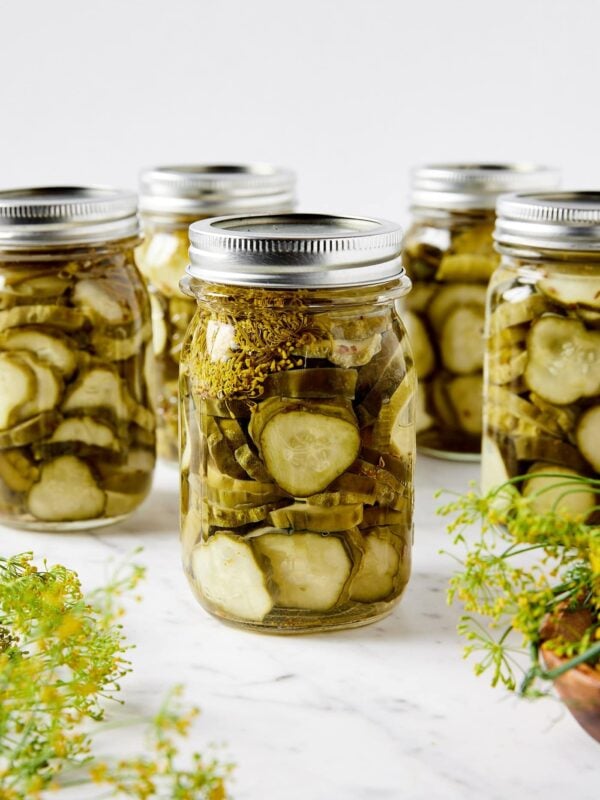

This is my second time making the Bread and Butter Pickles. The recipe is fantastic and easy to follow. My only struggle is picking cucumbers before they get too big!
I loved this recipe. It was just a touch too salty, so I will back it down a bit next time but I am keeping this recipe for next year’s pickling. So easy and the pickles are are so tasty and crisp
I had some Extra Brine so I just sliced up some more Cucumbers & Onions and threw them in a jar with the extra… Ate some the next day out of the Fridge, SO GOOD!! I can’t wait to taste the ones that I actually processed per this recipe!!
August 10/2024. Did your bread and butter pickles today. Anxious to taste them.
Hi Kaleb
I have a balcony garden and like to make your pickles but I don’t have that many pickles I do I make the recipe with less pickles? Is canning salt a must? Please let me know at your earliest. Thank you and I love watching your videos and great recipes. Thank you. Karen
Thanks for this great recipe, I made these last week and they are great !
Can I add cauliflower to this recipe for canning ?
Thanks