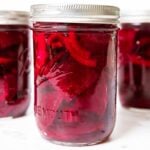
How to Can Pickled Beets
Pickled beets have a deep, earthy flavor that are so delicious during the summer. But when they’re canned, they’re great to enjoy year-round!
Servings: 6 pint jars
Equipment
- 6-7 sterilized pint-size canning jars
- lids and rings
Ingredients
For the brine
- 2 cups water
- 2 cups distilled white vinegar (5%)
- 2 tbsp granulated sugar (or honey) all the way up to 2 cups, depending on the sweetness desired
- 1 tsp kosher salt
For the beets
- 3 ½ lbs dark red beets (or any preferred variety)
- 1-2 large yellow or white onions (depending on preference, the amount of onion can be optional)
Instructions
- Start by washing beets. If using homegrown, make sure to leave the root on and cut the leaves to within an inch of the beet.3 ½ lbs dark red beets (or any preferred variety)
- Place in a large kettle and cover with water. Bring to a boil and let cook until tender. They’re ready when a knife is easily inserted with just slight resistance. Since beets vary in size, they may take varying times to cook. Remove them individually as needed.
- When cooked, drain (remove from water), let cool, and remove skins using a knife and gloves to prevent staining.
- Combine all the brine ingredients and let simmer on the stove.2 cups water, 2 cups distilled white vinegar (5%), 2 tbsp granulated sugar (or honey), 1 tsp kosher salt
- Also start a large kettle filled with water on high heat, fitted with a rack in the bottom. This will be used for a water bath.
- Using sterilized jars, slice onion to taste and place in each jar. Then fill with sliced beets. These can be sliced directly into the jars. If this is difficult, slice on a cutting board and pack jars.1-2 large yellow or white onions (depending on preference, the amount of onion can be optional)
- Top sliced beets with additional onion, leaving about a half-inch of headspace in the jar.
- Bring brine to a hard boil and fill each jar with the brine, leaving a half-inch of headspace.
- Clean the top of the jars with hot water to remove any debris and drips.
- Following the manufacturer’s directions, place lids and rings on jars, being careful not to over tighten (this can cause lids to buckle).
- Place prepared jars in boiling water bath, making sure water covers jars by at least one inch. Bring back to a boil and process for 30 minutes.
- Remove jars from kettle using a jar lifter and let cool completely before touching. Soon the lids should seal with a ping – music to a canner’s ears!
Video
Notes
Food safety tip – Home canning is safest when you follow research-tested recipes and proper processing times. Improper canning can risk botulism. New to canning? See my Canning 101 Guide and consult the USDA Complete Guide to Home Canning.
To prepare the beets, scrub them, wash them well to remove any soil, trim the stem to 1 inch in length, and leave the roots intact.
To determine whether a beet is fully cooked, poke it with a knife. It should be able to be easily inserted with a little resistance in the center.
Sterilize the jars before canning and adding the beets. This is important for both new and used jars, as it prevents contamination and spoilage.
Don't overtighten the jars. Otherwise, the lid could buckle, preventing a proper seal.
Nutrition
Serving: 0.5cup | Calories: 128kcal